Working at Height on Solar Canopies: What the Regulations Actually Require
Working at height on solar canopies is governed by the Work at Height Regulations 2005, which require employers and contractors to plan, supervise, and carry out all such work safely. Solar canopy installations present specific risks because they combine elevated structures with electrical systems and often involve mobile plant access beneath the canopy. This article covers the key regulatory requirements, duty holder responsibilities, and the practical controls that apply to canopy-specific working at height tasks.
Key takeaways
- The Work at Height Regulations 2005 apply at any height above ground level.
- Every risk assessment must identify unguarded edges, roof fragility, and load distribution issues specific to that canopy structure.
- Collective edge protection, such as fixed guardrails or scaffolding, takes legal precedence over personal fall arrest systems.
- Canopy frames projecting beyond supporting columns require edge protection solutions resolved at the design stage, not on site.
- A PASMA or IPAF qualification alone does not satisfy Regulation 5 competency requirements for solar canopy work.
- Supervisors must be named in the method statement before any work at height begins.
- Cleaning, inverter checks, and thermal imaging all constitute work at height and require the same planning rigour as installation.
What the Work at Height Regulations 2005 Require for Solar Canopy Installations
Treat every solar canopy installation as a working at height activity from the moment any person ascends above ground level. The Work at Height Regulations 2005 apply regardless of how low the structure sits, with no minimum height threshold. Employers must plan every task, supervise it, and assign only competent workers.
Fixed guardrails or scaffolding take precedence over personal fall protection wherever practicable. Where that is not feasible, workers must use collective fall arrest systems or, as a last resort, personal protective equipment including Petzl safety harnesses rated to the relevant EN standard.
All equipment used at height, including built-in anchor points, must be inspected at suitable intervals by a competent person, with records kept. Surfaces workers stand on must be stable, structurally sound, and free of slip or trip hazards.
Risk Assessment and Method Statements: Specific Requirements for Canopy Structures
Source: A&S Landscape (2025) | Spherical Insights UK Solar Carport Report (2025) | IBISWorld UK (2024)
A poorly drafted risk assessment is the single most common reason enforcement action follows a canopy installation incident. Under the Work at Height Regulations 2005, every risk assessment must identify the specific hazards of that structure: unguarded edges, roof fragility, uneven load distribution, and changing conditions during installation or maintenance.
Method statements must go beyond generic procedures by specifying the task sequence, equipment at each stage, and a rescue plan if a worker becomes suspended or incapacitated. Competent persons named in the statement must hold verifiable training records, not just assumed site familiarity.
Access points change between installation and ongoing maintenance, so a method statement written for the initial build will not cover a technician returning to clean panels or check connections. Separate documents are required for each distinct activity, with appropriate height safety equipment specified within each one.
Both documents must be reviewed whenever the structure, task, or workforce changes. The Health and Safety Executive treats undated or unreviewed assessments as evidence of inadequate planning, shifting liability onto the dutyholder.
Edge Protection, Guardrails, and Fall Arrest Systems on Solar Canopies
| Control Level | Example on Solar Canopy | WAHR 2005 Priority | HSE Preference |
|---|---|---|---|
| Avoid work at height | Remote monitoring systems; ground-level inverter access | 1st — Highest | ✅ Always consider first |
| Collective fall prevention | Fixed guardrails, scaffold platforms, edge protection barriers | 2nd | ✅ Preferred over PPE |
| Collective fall arrest | Safety nets or soft-landing systems beneath canopy deck | 3rd | ⚠️ Only if prevention not practicable |
| Personal fall restraint | Inertia reels, fixed anchor points, restraint lanyards | 4th | ⚠️ Limits reach to safe zone |
| Personal fall arrest (PPE) | Full-body harness, energy-absorbing lanyard, EN-rated anchor | 5th — Last resort | ❌ Only when all else is impracticable |
Passive edge protection fails on most solar canopy structures because the frame geometry leaves gaps that standard guardrail systems cannot bridge. Where a canopy projects beyond its supporting columns, the outer edge sits over open air with no natural anchor point for a conventional toe board and top rail. This must be resolved at the design stage.
The Work at Height Regulations 2005 require collective protection first, with personal fall protection only where collective measures are not reasonably practicable. Fixed guardrails or proprietary edge protection systems take precedence over harnesses and inertia reels. A fall arrest harness does not satisfy the hierarchy if guardrails could have been installed.
Where the structure cannot support a collective system, fall restraint is preferable to fall arrest. Restraint prevents a worker reaching an unprotected edge; fall arrest only engages after a fall begins, and on low-pitch canopies the clearance needed for safe deployment is frequently insufficient.
Anchor points fixed to the canopy frame must carry a minimum static load of 12 kN per person under BS EN 795. A structural engineer must sign off anchor locations, since solar canopy frames are not routinely designed with fall protection loads in mind.
Competency, Training, and Supervision Requirements for Canopy Work at Height
Regulation 5 of the Work at Height Regulations 2005 requires every operative on a solar canopy structure to hold demonstrable knowledge of the specific access equipment, fall protection systems, and structural characteristics in use. Generic height awareness training does not satisfy this requirement.
Supervisors must be named in the method statement before work begins. A qualification from PASMA or IPAF does not satisfy the supervisory duty unless the holder is physically present during critical tasks.
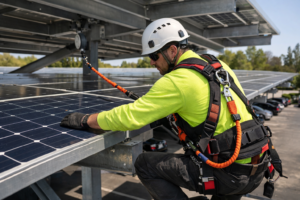
Training records must be available to the HSE on request. Check that each certificate names the access method actually deployed: mobile elevated work platforms, edge protection, or rope access, not a generic course. Expired certificates or those issued for different equipment types are a common investigation finding. Refresher intervals typically run three to five years, following the issuing body’s guidance.
Inspection, Maintenance Access, and Ongoing Compliance Obligations
Maintenance access failures cause more ongoing compliance gaps than installation errors. Under the Work at Height Regulations 2005, every subsequent task requiring access to the panel surface, including cleaning, inverter checks, and thermal imaging, constitutes work at height and demands the same planning rigour as the original installation. Soiling, shading, and connection degradation all require physical inspection to diagnose, making routine access unavoidable.
The duty holder must document a safe system of work before commissioning, specifying the access method and recording it in a site-specific maintenance plan. Options include a mobile elevating work platform, a fixed ladder, or scaffold. Retrofit access solutions frequently fall short because the original structure was not designed to accommodate anchor points or edge protection for a different method.
The Health and Safety Executive expects employers to review risk assessments whenever site conditions change, including after storm damage, panel replacements, or structural modifications. A canopy that passed inspection at commissioning may present different hazards if a supporting column has shifted or anchorage points have corroded. Scheduled re-inspection intervals must be written into the maintenance contract and retained as compliance evidence.
Frequently Asked Questions
What are the specific regulations for working at height on solar canopies?
The Work at Height Regulations 2005 govern all solar canopy installation and maintenance tasks. They require employers to plan work in advance, use competent workers, and select appropriate equipment. Where collective protection (such as guardrails) is not practicable, personal fall arrest systems must be used instead.
What safety measures are required when installing solar panels on canopies?
UK law treats canopy installation as work at height, which triggers specific legal duties under the Work at Height Regulations 2005. Employers must provide edge protection or collective fall-arrest systems, conduct a written risk assessment, and ensure workers hold documented competency. Personal protective equipment alone does not satisfy the regulations.
How does the Work at Height Regulations 2005 apply to solar canopy projects?
Plan every task above ground level as working at height before work begins. The Work at Height Regulations 2005 require employers and contractors to eliminate the risk where possible, then use collective protection measures such as guardrails before relying on personal fall arrest equipment. Solar canopy installations, including panel fitting and structural assembly, fall fully within this duty.
What training is necessary for workers involved in solar canopy installations?
Every worker must hold a recognised working at height qualification before accessing a canopy structure. This typically means PASMA certification for mobile tower use, IPAF for elevated work platforms, and a current first aid certificate. Supervisors require additional competency in rescue planning and emergency procedures under the Work at Height Regulations 2005.
What are the penalties for non-compliance with height safety regulations in solar canopy work?
The Health and Safety Executive can issue unlimited fines and custodial sentences of up to two years for serious breaches. Prohibition notices stop work immediately; improvement notices require specific remedial action within a set timeframe. Directors and sole traders face personal liability, meaning penalties apply to individuals, not just the business entity.