The Environmental Impact of Solar Energy: Facts You Should Know
Solar energy generates significantly lower greenhouse gas emissions over its lifetime compared to fossil fuels. However, the manufacturing process, land use, and end-of-life disposal of solar panels each have measurable environmental costs. To understand the full impact, it is essential to look beyond just the absence of combustion emissions. This article explores the carbon footprint of solar panel production, the demands of resource extraction, the consequences of land use, and how the industry is tackling waste from decommissioned panels.
Key takeaways
- Silicon panels recover the energy used in their manufacturing within 1 to 4 years and then operate cleanly for an additional 25 to 30 years.
- Solar farms located on brownfield or degraded land have a significantly lower ecological impact compared to those on functioning ecosystems.
- Coal plants emit between 800 and 1,000 grams of CO2 per kilowatt-hour, while crystalline silicon panels emit only 20 to 50 grams over their entire lifetime.
- Cadmium telluride panels require proper processing at the end of their life to prevent contamination from toxic heavy metals.
- The volume of panels reaching the end of their life in the coming decades presents a greater recycling challenge than the chemistry of the panels themselves.
- Rooftop and building-integrated solar installations nearly eliminate land use and habitat disruption.
- A fair emissions comparison necessitates a full lifecycle assessment that includes manufacturing, installation, operation, and decommissioning.
How Solar Panels Are Manufactured and What That Costs the Environment
Check the energy payback period before comparing solar to fossil fuels. Silicon-based panels typically recover their manufacturing energy within 1 to 4 years and then generate clean electricity for an additional 25 to 30 years. Understanding how solar energy works helps to put that manufacturing footprint into proper context.
Producing photovoltaic cells requires high-purity silicon, which demands temperatures above 1,400°C during purification. This step consumes significant electricity, and if the factory relies on coal-heavy grid power, the carbon cost increases sharply. Thin-film panels using cadmium telluride bypass the energy-intensive silicon refining process but introduce cadmium, a toxic heavy metal that requires careful handling during both production and end-of-life stages.
Water use is another concern. Semiconductor manufacturing relies on ultrapure water for cleaning wafers, with some facilities consuming hundreds of litres for each panel produced. Manufacturers in water-stressed regions face increasing pressure to close these water loops through recycling systems.
Frame and backing materials also affect the carbon calculation. Aluminium frames require energy-intensive smelting; however, using recycled aluminium reduces that footprint by roughly 95% compared to primary production. Several European manufacturers now source recycled aluminium as standard, which significantly lowers the carbon intensity of each unit leaving the factory.
Land Use, Habitat Disruption, and the Footprint of Large-Scale Solar Farms
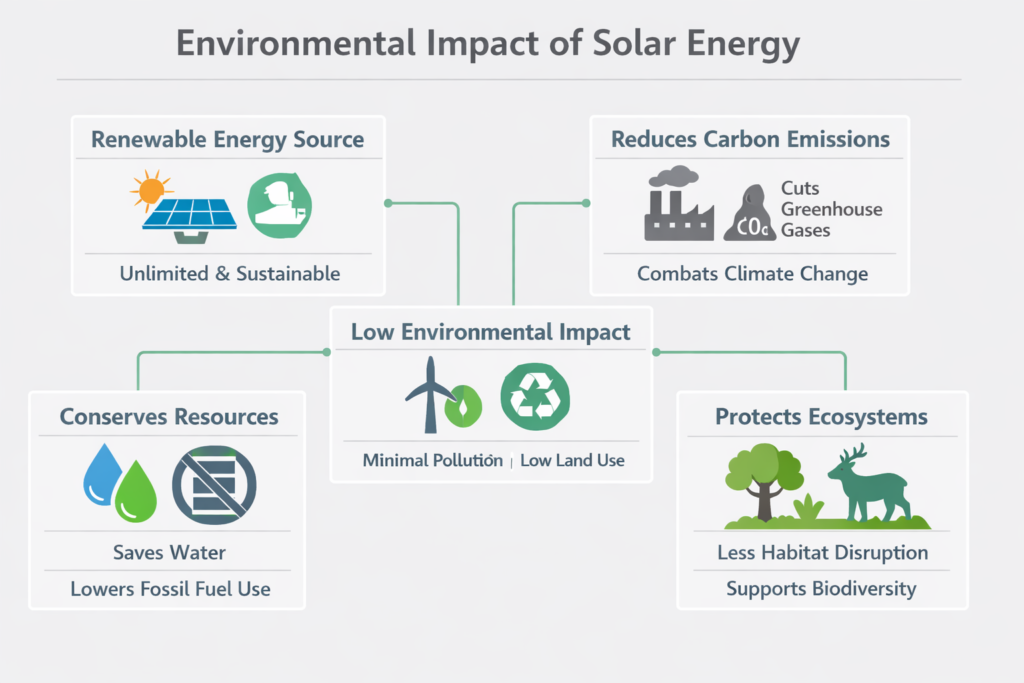
Utility-scale solar farms, which can cover hundreds of hectares, may displace agricultural land, grassland, and wildlife corridors. The extent of this disruption largely depends on site selection. Installations on degraded land, brownfield sites, or rooftops have a significantly lower ecological cost compared to those built on functioning ecosystems.
Removing vegetation alters local drainage patterns and can hinder habitat connectivity for pollinators and ground-nesting birds. Researchers have discovered that careful panel spacing, the use of native ground cover beneath arrays, and perimeter planting can help partially restore biodiversity. This practice is increasingly mandated by planners in the UK under biodiversity net gain regulations.
Agrivoltaic designs directly address land-use conflicts by integrating crop production or livestock grazing with solar generation on the same land. When assessing the long-term environmental impact of solar energy compared to conventional sources, solar energy consistently demonstrates a substantially lower footprint throughout its operational lifespan, even when considering land disturbance during construction.
Carbon Emissions Over a Solar Panel’s Lifetime Compared to Fossil Fuels
Source: IPCC assessments
Calculating emissions solely at the point of generation provides an incomplete picture. A fair comparison necessitates a lifecycle assessment that includes manufacturing, installation, operation, and decommissioning for all energy sources.
Natural gas plants emit between 400 and 650 grams of CO2 equivalent per kilowatt-hour over their lifetime, while coal plants produce 800 to 1,000 grams. Crystalline silicon solar panels generate approximately 20 to 50 grams per kilowatt-hour throughout their full lifecycle, according to IPCC assessments. Virtually all of this emission is attributable to manufacturing rather than operation. Thin-film technologies, such as cadmium telluride, sit toward the lower end of that range, requiring less energy-intensive processing than monocrystalline silicon. As electricity grids incorporate more renewables, the carbon cost of panel manufacturing continues to decline.
Over a typical 30-year operational lifespan, a rooftop installation offsets significantly more carbon than its manufacture produces. This ratio improves as both efficiency and panel longevity advance.
Toxic Materials, Recycling Challenges, and End-of-Life Panel Disposal
- Reduced carbon emissions during operation.
- Potential for recycling materials like aluminium.
- Presence of toxic materials like cadmium.
- Challenges in recycling and disposal processes.
Cadmium telluride panels contain cadmium, a toxic heavy metal that poses serious environmental risks if the panels are broken, landfilled, or incinerated instead of being properly processed. In contrast, crystalline silicon panels are less hazardous chemically, but their aluminium frames, copper wiring, and encapsulant resins still require separation at the end of their life cycle.
A more pressing issue is the volume of waste generated. Solar capacity installed during the 2000s and 2010s will reach the end of its life in large quantities starting in the mid-2030s, resulting in millions of tonnes of waste annually. While glass recovery works reasonably well, extracting high-purity silicon and silver from solar cells remains technically complex and commercially marginal.
The PV CYCLE scheme offers producer-funded collection and recycling across Europe under the WEEE Directive. However, outside Europe, regulatory frameworks are inconsistent, leading many decommissioned panels to enter general waste streams. Choosing manufacturers that participate in certified take-back programmes can help reduce the risk that end-of-life disposal negates the environmental benefits gained during operation.
Net Environmental Verdict: Where Solar Stands Against Other Energy Sources
| Energy Source | Carbon Emissions (g CO2/kWh) |
|---|---|
| Natural Gas | 400-650 |
| Coal | 800-1000 |
| Crystalline Silicon Solar | 20-50 |
| Thin-Film Solar | Lower end of the range |
Solar photovoltaic generation produces between 20 and 50 grams of CO2 equivalent per kilowatt-hour over its entire lifecycle. In contrast, coal plants emit 800 to 1,000 grams in the same measure. This significant gap persists even when considering manufacturing, land preparation, and decommissioning.
Land use and habitat disruption are solar’s most notable weaknesses. However, rooftop and building-integrated installations largely mitigate this issue. The end-of-life disposal of cadmium-containing thin-film panels presents real challenges. Still, the total toxic burden per unit of electricity generated is much lower than that of coal combustion residuals or oil extraction.
The IPCC Sixth Assessment Report ranks solar as one of the lowest-impact electricity sources regarding water consumption, air pollution, and greenhouse gas intensity. Solar’s environmental costs are primarily concentrated in manufacturing and disposal, while fossil fuel costs accumulate continuously during operation. This structural difference weakens the position of fossil fuels across a solar panel’s full operating life.
Frequently Asked Questions
What are the key environmental benefits of solar energy?
Solar energy generates no direct greenhouse gas emissions during operation. It greatly decreases reliance on fossil fuels, thereby reducing air pollutants associated with respiratory diseases. Over a panel’s 25 to 30-year lifespan, the carbon savings significantly exceed the emissions generated during manufacturing and installation.
How does solar energy production affect wildlife habitats?
Large ground-mounted solar farms can displace native vegetation and fragment animal habitats, especially when constructed on undeveloped land. In contrast, rooftop and brownfield installations completely avoid this issue. By carefully selecting sites, using wildlife-friendly fencing, and planting native ground cover beneath the panels, developers can significantly reduce ecological disruption on larger sites.
What materials are used in solar panels and how are they sourced?
Before purchasing, check the panel specification sheet. Most solar panels use silicon as the primary semiconductor, which is predominantly sourced from quartz sand. The remaining structure consists of aluminium frames, copper wiring, and glass. Thin-film panels, on the other hand, use cadmium telluride or copper indium gallium selenide. These materials require more careful end-of-life handling due to their toxicity concerns.
What is the carbon footprint of manufacturing solar panels?
Manufacturing solar panels generates carbon emissions, mainly due to the energy-intensive processes of silicon purification and cell fabrication. Lifecycle emissions are typically estimated at 20–50 grams of CO₂ equivalent per kilowatt-hour. However, most panels offset these manufacturing emissions within 1–4 years of operation, subsequently producing low-carbon electricity for an additional 25–30 years.
How does solar energy compare to fossil fuels in terms of environmental impact?
Solar panels generate electricity with near-zero operational emissions, in stark contrast to coal, which produces 820g of CO₂ per kilowatt-hour. Over a panel’s 25–30 year lifespan, lifecycle emissions average between 20 and 50g CO₂/kWh. This positions solar as one of the lowest-impact electricity sources available, effectively avoiding the air pollution, carbon output, and extraction damage associated with fossil fuels.