Do Solar Canopies Need Planning Permission? UK Rules by Use Case.
In most cases, solar canopies require planning permission. However, permitted development rights eliminate this requirement for certain residential and commercial installations. Whether permission is necessary depends on the structure’s size, location, and intended use. This article outlines the planning rules for domestic gardens, car parks, agricultural land, and sites in listed or conservation areas, providing clear answers for each common use case.
Key takeaways
- UK planning law classifies solar canopies based on their physical form rather than their function.
- Most residential canopies fall under permitted development rights, but the conditions are strict.
- Canopies exceeding 4 metres in height do not qualify for permitted development, regardless of the number of panels.
- Full planning permission is generally required for solar canopies on commercial sites and car parks.
- A Lawful Development Certificate costs about half the fee of a full planning application.
- Article 4 Directions can revoke permitted development rights without notifying the landowner.
- Always verify whether the canopy is considered an enlargement of the original dwelling.
What Counts as a Solar Canopy Under UK Planning Law
Before assuming any canopy structure falls under solar panel rules, check the Town and Country Planning (General Permitted Development) (England) Order 2015. UK planning law does not define “solar canopy” as a distinct category.
Planning authorities evaluate solar canopies based on their physical form rather than their function. A freestanding structure with a photovoltaic roof is classified as a building or engineering operation, not merely as solar equipment attached to an existing roof. This distinction influences which permitted development rights apply and whether a full planning application is necessary.
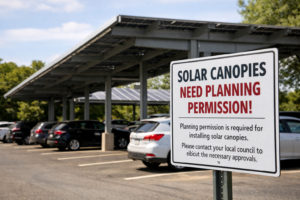
Assessors consider several key factors, including the structure’s height, footprint, whether it is attached to a building, and the land it occupies. A canopy in a domestic garden is assessed differently than one in a commercial car park or on agricultural land. Each land classification has its own set of permitted development thresholds and conditions.
Permitted development rights for solar equipment, outlined under Class A of Schedule 2, Part 14 of the GPDO, were primarily designed for roof-mounted panels. Freestanding canopies benefit from these rights only in limited circumstances, particularly on domestic land and within strict size limits. Structures that exceed these limits or are located on non-domestic land typically require express planning consent, regardless of whether they generate electricity.
Permitted Development Rights for Solar Canopies: Where They Apply
Getting planning permission right from the start helps avoid enforcement notices and costly removals. Permitted development (PD) rights eliminate the need for a formal application for most residential solar canopy installations, but their conditions are strict. Missing just one condition removes that protection entirely.
According to the Town and Country Planning (General Permitted Development) (England) Order 2015, solar equipment on a domestic dwelling qualifies for PD rights if it protrudes no more than 200mm from the surface, remains below the roof’s highest point, and is removed when no longer needed. A carport with a photovoltaic roof may qualify if it meets these criteria and the property is outside a designated area.
Freestanding garden canopies must be positioned more than 5 metres from the boundary and cover no more than half of the garden. PD rights do not apply on Article 2(3) land, which includes National Parks, Areas of Outstanding Natural Beauty, conservation areas, and World Heritage Sites. Listed buildings face additional restrictions regardless of location, and Scotland, Wales, and Northern Ireland each operate under distinct regulations.
When Planning Permission Is Required for a Solar Canopy
- Ensures compliance with local regulations
- May avoid future enforcement issues
- Can be time-consuming
- May incur application fees
Exceeding the physical thresholds set by the Town and Country Planning (General Permitted Development) (England) Order 2015 removes the protection of permitted development. A canopy taller than 4 metres or one that projects beyond the principal elevation falls outside the permitted development envelope, regardless of the number of panels.
Commercial and mixed-use sites typically require full planning permission. Car park canopies at supermarkets, leisure centres, or offices are classified as engineering operations under the Town and Country Planning Act 1990, and no permitted development class covers them. Agricultural installations exceeding 1 megawatt face the same requirement unless the agricultural prior approval route applies.
Stricter rules apply to listed buildings and conservation areas. Any canopy visible from a public highway in these designations requires full planning consent under listed building consent rules, where permitted development rights are either withdrawn or subject to tighter dimensional limits.
Article 4 Directions can also trigger the need for planning permission. Local authorities issue these directions to remove permitted development rights across specific streets or neighbourhoods, making a normally permission-free canopy subject to a formal application. It is advisable to check the Planning Portal property search or contact the local planning department before proceeding.
Solar Canopy Rules by Use Case: Residential, Commercial, and Car Parks
| Use Case | Planning Permission Required |
|---|---|
| Residential | May not require if under permitted development rights |
| Commercial | Typically requires full planning permission |
| Car Parks | Requires planning permission as classified engineering operations |
Residential canopies attached to a house benefit from permitted development if they meet specific height and projection limits. However, detached garden structures with a photovoltaic roof face stricter thresholds and may require a lawful development certificate, even when full planning permission is not necessary. Always check if the canopy constitutes an enlargement of the original dwelling, as this affects which permitted development rules apply.
Commercial installations on retail premises, schools, or industrial sites typically require a formal planning application. Their scale usually places them outside any permitted development class. Car park canopies almost always trigger planning requirements due to their height, footprint, and proximity to public roads. When multiple canopies are proposed across a single site, each structure may be assessed individually, which can extend the approval timeline.
For all three use cases, submitting a pre-application enquiry to the local planning authority can provide written guidance before costs accumulate. This step is particularly useful if the site is near a boundary or within a defined flood risk zone, as additional conditions may apply. Installations on listed buildings or within conservation areas may also require listed building consent alongside standard planning permission.
How to Check and Apply for Solar Canopy Planning Permission
Before submitting any formal documents, check your local planning authority’s (LPA) website to confirm whether permitted development applies. Article 4 Directions can remove these rights in designated areas without notifying the landowner.
For most residential installations, a Lawful Development Certificate (LDC) costs roughly half the fee of a full planning application. It produces a legally binding record, which is useful when selling or securing financing.
If full planning permission is required, submit your application through the Planning Portal. Include a site location plan, proposed elevations, and a design and access statement. LPAs typically make decisions within eight weeks. A planning consultant familiar with solar panel canopies can help reduce the risk of objections related to visual impact, drainage, or highway access, especially on commercial and car park sites.
For conservation areas, National Parks, or Areas of Outstanding Natural Beauty, contact Historic England or your LPA’s conservation officer before finalising the design. Most LPAs offer pre-application advice for a fee, providing written feedback early enough to adjust the scheme rather than appeal a refusal.
Frequently Asked Questions
What are the general planning permission requirements for solar canopies in the UK?
In the UK, most solar canopies require planning permission. While permitted development rights may apply in certain residential and commercial cases, factors such as size, location, and use significantly influence eligibility. Installations located near listed buildings, in conservation areas, or on non-domestic land typically require a formal application.
Do residential solar canopies require planning permission in all cases?
Permitted development rights apply to many residential solar canopies, meaning planning permission is not always necessary. Key factors include installation height, proximity to boundaries, and whether the property is listed or located in a designated area, such as a conservation zone. Properties with these restrictions usually require formal consent.
What specific use cases for solar canopies may exempt them from planning permission?
Residential carports attached to a house typically qualify as permitted development, as long as they adhere to height and size limits. Canopies over private driveways, school playgrounds, and agricultural land may also bypass the requirement for full planning consent. Business installations in specific commercial zones can qualify too, although permitted development rights differ by local authority.
How do local council regulations affect the planning permission for solar canopies?
Local councils have the authority to impose stricter rules than those outlined in national permitted development rights. Some councils have opted to remove or restrict these rights for solar installations using Article 4 Directions. It is essential to consult your local planning authority before proceeding, as permitted development conditions differ by area. These conditions can influence height limits, siting requirements, and design standards.
What steps should be taken if planning permission is denied for a solar canopy installation?
Applicants have three years from the date of refusal to submit an appeal to the Planning Inspectorate. Before appealing, carefully review the refusal notice. Specific objections, such as design or siting, can often be resolved by submitting a revised application that directly addresses the raised concerns.